
Thai silk is more than a fibre test. Learn what the four Royal Peacock marks certify, how to check a traceability number and which questions reveal the maker, place, method and care behind the cloth.
Thai silk is more than a fibre. In the right piece of cloth, you can find a silkworm strain, a reeling method, a loom, a dye process, a pattern, a maker and a place. Yet those layers are often compressed into one sales phrase: “real Thai silk.”
That phrase is not enough to make a confident purchase. A textile can contain genuine silk without preserving a traditional production process. A beautiful pattern may be associated with a region without being protected by a geographical indication. A reputable shop may sell different categories of fabric. And a high price is not evidence by itself.
The better approach is to ask what the textile can prove, then decide whether that evidence matters for the way you plan to wear, give or keep it.
For more destination and experience ideas, explore Thailand with Privelza.
Begin with the decision you are making
Before looking for a label, decide what you want from the purchase. A collector may care most about traditional production and named provenance. Someone commissioning a jacket may prioritise drape, consistency, enough matching meterage and clear care instructions. A gift buyer may need a traceable story and practical presentation. Everyday clothing may benefit from a blend if the composition and performance are stated honestly.
This matters because Thailand’s official silk marks are categories, not a single ladder from bad to good. The most traditional option is not automatically the best option for every garment, climate, budget or maintenance routine.
Read the Royal Peacock mark as a production category
The official Royal Peacock definitions distinguish four ways a certified textile may be made. Look at the English category name as well as the colour. Lighting, printing and screen images can make colour alone unreliable.
Gold Peacock (Royal Thai Silk)
Gold is the most tightly defined traditional category. The official criteria require indigenous Thai silkworm varieties for both warp and weft, hand reeling, a traditional hand-operated loom with a hand-thrown shuttle, approved dye practice and production in Thailand.
Choose it when the preservation of traditional materials and process is central to the purchase. Do not assume that the mark alone tells you who received the value, which community owns a pattern, how the fabric will behave as clothing or whether a particular dye claim is correct.
Silver Peacock (Classic Thai Silk)
Silver allows indigenous or improved Thai silk varieties in the warp and/or weft. Reeling may be done by hand or with equipment driven by a motor of no more than five horsepower, and weaving may use a handloom with a hand-thrown shuttle or a fly-shuttle loom. Production must be in Thailand.
This category retains a strong relationship with Thai silk knowledge while permitting selected production adaptations. It may suit buyers who want a defined Thai process with somewhat greater flexibility in production.
Blue Peacock (Thai Silk)
Blue requires genuine silk in both warp and weft, allows any loom, and must be produced in Thailand. The category combines Thai knowledge with production technology suited to contemporary and commercial use.
Blue is not “fake” or automatically lesser because it permits more production flexibility. It may offer qualities a garment or interior application needs. Ask about weave, weight, finish and care rather than treating the colour as a score.
Green Peacock (Thai Silk Blend)
Green identifies a blend in which genuine silk is the main component and another natural or synthetic fibre is secondary. The other fibre must be stated clearly. Any loom may be used, and production must be in Thailand.
A declared blend can be an honest, useful choice for wearability, cost, structure or care. The important question is not whether the textile is “pure” enough for someone else’s purpose, but whether the exact composition and performance suit yours.
Verify the label, not just the sales story
The Queen Sirikit Department of Sericulture’s official traceability portal allows consumers to check a Royal Peacock label. Current labels use a 2D barcode and a unique number. You can scan the code or enter the number manually.
- Gold Peacock uses the prefix R.
- Silver Peacock uses the prefix C.
- Blue Peacock uses the prefix T.
- Green Peacock uses the prefix B.
For manual entry, the portal instructs users to enter the letter prefix, one space, the Thai character ก and the seven-digit number. For example, R ก0138801. Older labels have a separate lookup route.
A successful record may show the silk standard, fabric and pattern information, producer, production location, certification details and silk variety. Treat the result as product-level evidence. If the code does not resolve, ask the seller to check the formatting and explain the record before you buy. Do not rely on a photograph of a label that cannot be connected to the textile in front of you.
Know what three different certifications can tell you
Royal Peacock mark
This answers a specific question. Under which certified Thai-silk production category was this textile approved?
Thai geographical indication
A geographical indication, or GI, identifies a registered product whose quality or reputation is connected to a defined place. Producers using the Thai GI symbol must operate within the registered scope and follow its control system. This answers a different question. Does this product meet the registered place-linked specification?
Certified Thai Silk Shop
The Department of Sericulture also certifies retail shops and publishes a dataset of certified establishments. This can help you choose where to begin, but shop certification and product certification are not interchangeable. Check the individual textile and its label.
Lamphun Brocade Thai Silk shows how the systems can complement each other. Its official GI registration defines a raised brocade technique, production requirements and a geographical area within Lamphun province, with producer registration and traceability controls. The GI supports a place-linked claim. A Royal Peacock mark, where present, describes the silk-production category.
Ask eight questions before paying a premium
- What is the exact fibre composition? Ask for percentages when the textile is a blend.
- Which Royal Peacock category applies to this piece, and where is its label or traceability number?
- Does the official record match this textile’s producer, pattern, place and category?
- Who made or wove it? Ask for the person, group, workshop or producer rather than accepting “village made” as a complete answer.
- Where were the silk, reeling, dyeing and weaving stages carried out? The answer may involve more than one place.
- What is the weave or pattern called, and who should be credited for it? Avoid treating a community or ethnic pattern as anonymous decoration.
- What dye, finish and care method apply to this exact piece? General silk advice never overrides the maker’s or garment’s care label.
- If it will be tailored, is there enough matching fabric, what is the usable width, and should it be pre-treated before cutting?
Keep the receipt and photograph the label and traceability result. If the story adds value to the price, the evidence should travel with the purchase.
Match the textile to the way you will use it
For clothing
Check weight, drape, opacity, friction, lining needs and how the fabric reacts to seams. If you are commissioning a garment, let the tailor inspect the cloth before cutting. Ask whether pre-treatment is needed and how much extra material is required for pattern matching.
For scarves and gifts
Prioritise a clear composition, maker and place story, plus care instructions the recipient can actually follow. A smaller traceable piece can carry more meaning than an expensive item supported only by generic heritage language.
For interiors or longer-term use
Ask about light exposure, abrasion, cleaning and colour consistency across lengths. A delicate handwoven textile may be better displayed away from direct sun than used on a high-contact surface.
Care begins before checkout
Silk is a protein fibre, but care varies with dye, weave, finish, lining and construction. The Department of Sericulture publishes general silk care guidance, including avoiding excessive heat, harsh handling and direct sun during drying, but the safest instruction is the one supplied for the exact textile or finished garment.
If a seller cannot explain care, colourfastness or whether the fabric should be pre-treated before tailoring, pause. Care information is part of provenance because it shows whether the seller understands what is being sold.
Do not make the certificate prove more than it does
A Royal Peacock mark can support claims about defined materials and production methods. It does not, by itself, establish fair wages, worker ownership, organic farming, a complete environmental footprint, zero chemical use, cultural permission for every design, or superior performance for every purpose.
Those may still be important questions. Ask them separately, and look for evidence appropriate to each claim. Responsible buying begins when certification narrows uncertainty. It does not end there.
Let the textile lead you toward a place
Thailand’s recent THAI T’REASURES programme framed fashion as a route into ten textile journeys, connecting contemporary design with communities and destinations. The event itself has concluded, but the idea remains useful. A pattern or maker can become the beginning of a journey rather than the end of a shopping transaction.
A Lamphun brocade may lead you to the province’s weaving history and registered production area. A seller who names an Isan weaving group should be able to tell you where it is and how the work reaches the shop. A contemporary designer using regional cloth should be able to explain the collaboration and attribution.
You do not need to turn every purchase into a research project. You do need enough information to understand why the textile costs what it does and whose story you are carrying.
The Privelza view
The strongest Thai-silk purchase is not automatically the most traditional, expensive or elaborate. It is the piece whose material, method, maker, place and intended use form a story you can verify and continue to value after the first impression.
Start with purpose. Read the Royal Peacock category correctly. Check the traceability record. Separate product certification from GI and shop status. Ask who made the textile and how to care for it.
When the evidence travels with the cloth, you are not only buying silk. You are keeping its story intact.
Read more considered guides in The Privelza Selection, or join Privelza Circle for carefully selected Thailand stories.
Research note: Core official sources were checked on 2 October 2026. Certification records, shop status and individual traceability entries can change, so verify the exact product and current record before purchase. This is independent editorial content. No retailer, designer, producer, tourism organisation or government agency provided payment, product, hosted access or editorial approval. Privelza has not inspected, purchased or tested a named textile for this article.
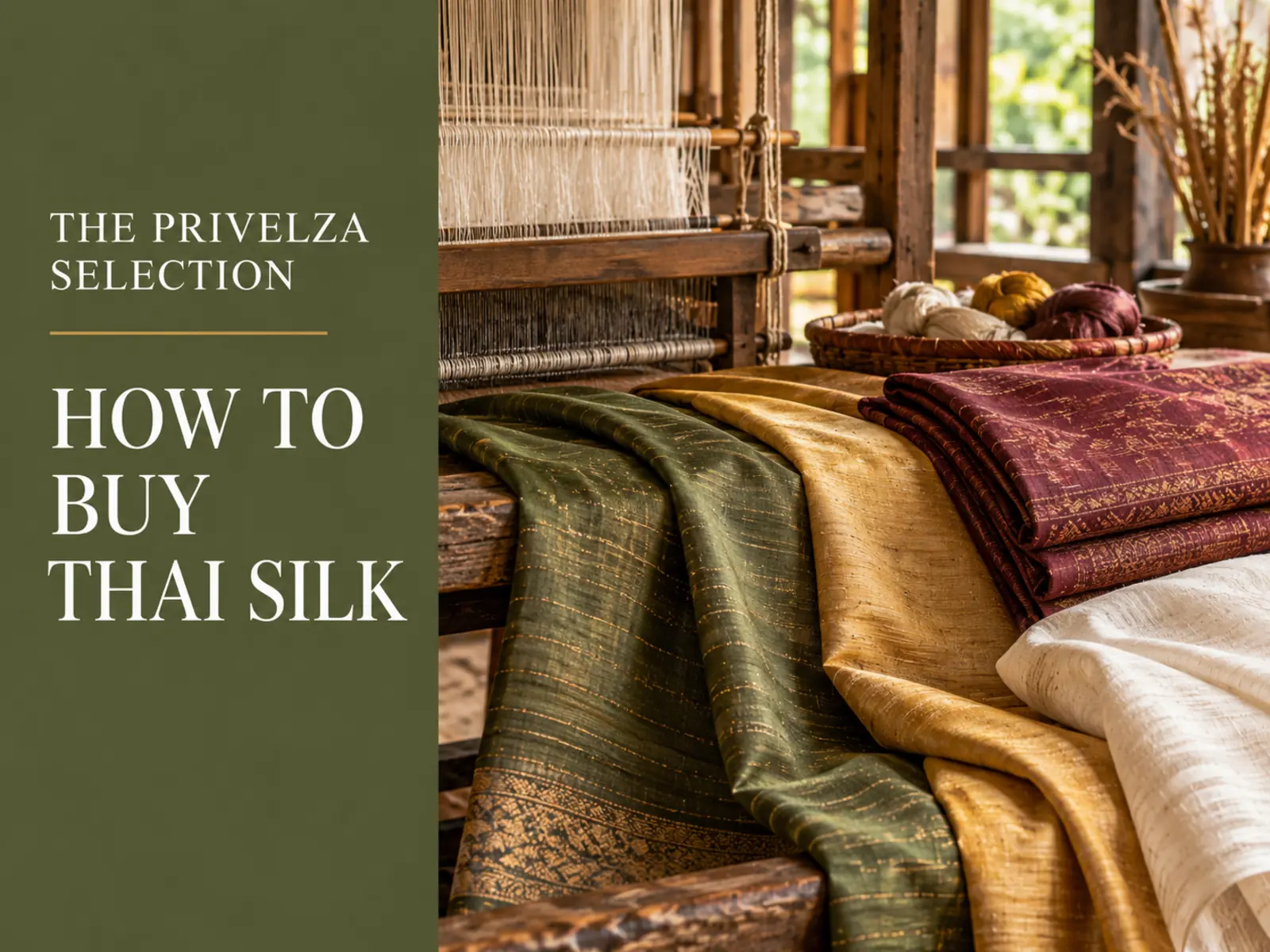
Featured image: AI-generated editorial illustration. It does not depict a specific shop, producer or certified textile.