
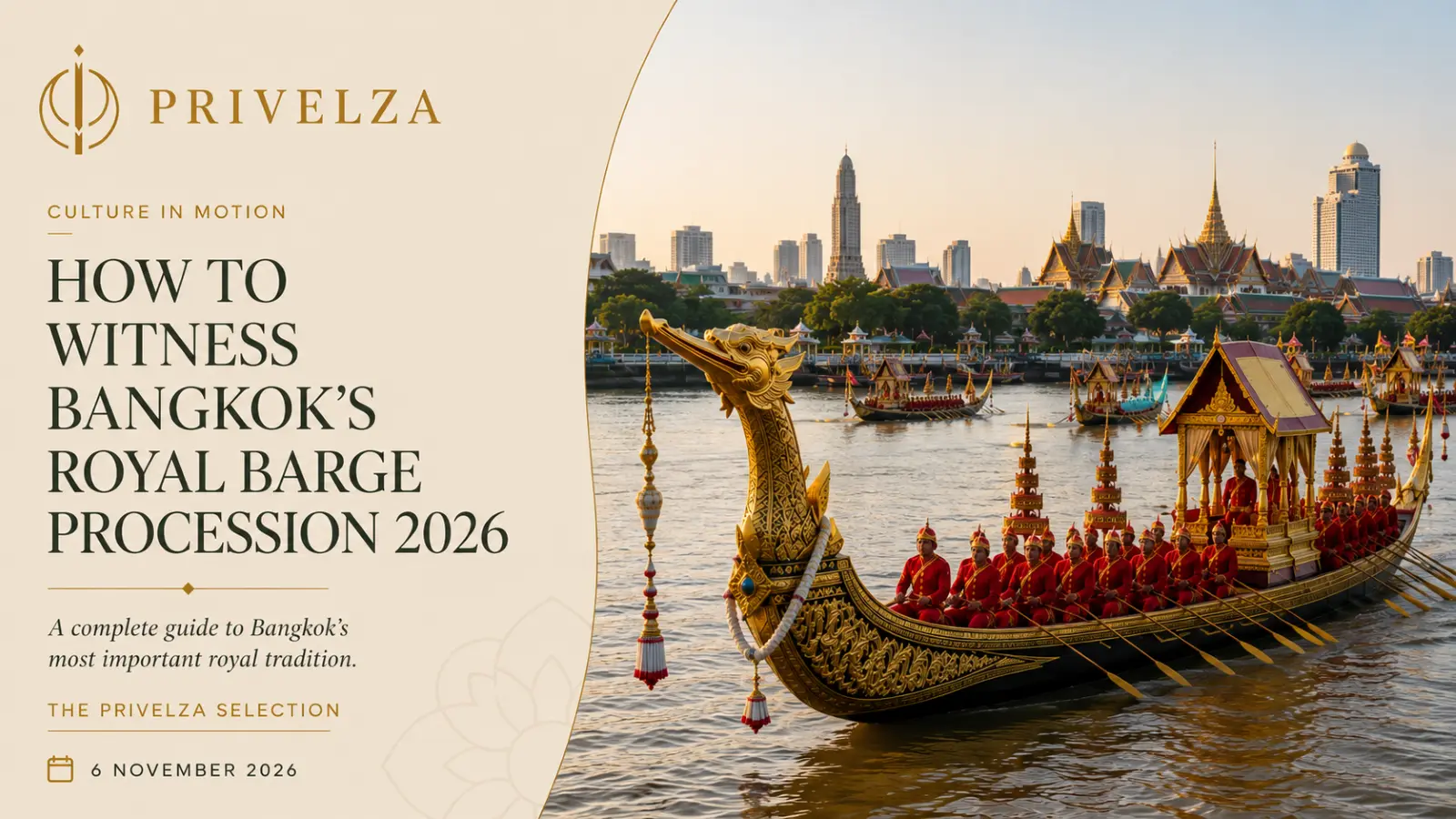
On most afternoons, the Chao Phraya is a working river: ferries cross between neighbourhoods, express boats carry commuters and hotel shuttles move between piers. During a Royal Barge rehearsal, that familiar river becomes ceremonial space.
The 2026 Royal Barge programme culminates in the Royal Kathin ceremony at Wat Arun on 6 November 2026. This guide retains live official schedule links because rehearsal times, access and transport arrangements can still change.
Royal Barge processions are reserved for major royal and religious occasions, with public rehearsal programmes announced for each event. Before planning a visit, use the newest TAT Newsroom and Thailand Government Public Relations Department notices to confirm whether a programme is active, the current schedule and the viewing arrangements that apply.
This is not simply a large river event. It is a royal and religious ceremony shaped by generations of craftsmanship, poetry, music and disciplined coordination. The experience is more meaningful when you understand what is moving past you—and when you plan carefully enough that logistics do not overwhelm the moment.
Why the procession matters
Kathin is a Buddhist merit-making tradition after the end of Buddhist Lent, when robes and other offerings are presented to monks. When the monarch performs the offering at a royal temple, it becomes a Royal Kathin ceremony. For this procession, His Majesty the King will present Kathin robes at Wat Arun in honour of Her Majesty Queen Suthida’s fourth-cycle birthday anniversary.
Thailand’s ceremonial use of royal barges reaches back through the Ayutthaya period and is connected to an even longer history of life, transport and state ceremony on water. The Fine Arts Department account of the Royal Barges explains how royal vessels came to serve important religious and state occasions and how waterborne processions developed into a highly ordered royal tradition.
That continuity matters. The Chao Phraya is not being used as a decorative background; the river is part of the ceremony itself.
What you will see on the river
The official formation contains 52 royal barges crewed by 2,200 Royal Thai Navy personnel. Arranged in five columns and three lines, the procession extends approximately 1.2 kilometres in length and 90 metres across. Those numbers describe the scale, but not the visual rhythm: gilded prows, mythological figures, synchronised oars and ceremonial order moving together along the river.
Four principal royal barges anchor the formation:
- Suphannahong, the Golden Swan, with its distinctive gilded swan-shaped bow.
- Anantanakkharat, identified by the multi-headed naga at its bow.
- Narai Song Suban King Rama IX, depicting the deity Narai mounted on Garuda.
- Anekkachatphutchong, decorated with numerous small naga figures.
The current Suphannahong was completed in 1911 and later received the World Ship Trust Maritime Heritage Award in 1992. The Government Public Relations Department overview places it within the much older lineage of the Suphannahong royal barge and the wider Ayutthaya-era tradition.
The Royal Thai Navy preparation report also shows how much of the procession depends on sustained rehearsal. The precision visible from the riverbank is the result of months of training by personnel assigned across the ceremonial fleet.
Find the current official schedule
Royal Barge Procession and rehearsal programmes are announced for specific royal occasions. Dates, start times, viewing areas and transport controls can change, so a copied schedule can quickly become misleading.
Use the newest official notice before making plans:
- Search TAT Newsroom for “Royal Barge Procession” and open the most recent official visitor-information notice.
- Check the Thailand Government Public Relations Department for a matching ceremony or rehearsal announcement.
- If the notices differ, follow the most recent official instruction or contact the TAT Contact Centre on 1672.
- Recheck on the day for weather, security, road and river-service changes.
Official programmes may distinguish between minor rehearsals, full-dress rehearsals and the main ceremony. A minor rehearsal offers a working version of the formation. A full-dress rehearsal is closer to the ceremonial presentation, while the main day carries the greatest religious and royal significance and usually the strictest access controls. The right choice depends on whether your priority is flexibility, ceremonial completeness or the main occasion itself.
Understand the route before choosing a viewpoint
The procession begins at Wasukri Pier and travels downstream past Phra Sumen Fort, Somdet Phra Pinklao Bridge, Siriraj Hospital, the Grand Palace and the Royal Thai Navy Auditorium before arriving at Wat Arun. Official public information identifies both banks of the river between Krung Thon Bridge and Wat Arun as the general viewing corridor.
That corridor is extensive, but it should not be read as a guarantee that every riverfront space will be open or suitable. Hotels, temples, restaurants, private piers and institutional grounds control their own access. Security zones and transport arrangements may also change by date.
Use the published route to think in three broad zones rather than chasing an unverified “best spot”:
- Upstream and approach: areas nearer Krung Thon Bridge and Wasukri Pier can provide an earlier view of the formation, with fewer of Bangkok’s most recognisable monuments in the background.
- Central ceremonial river: the stretches around Siriraj, the Grand Palace and the Royal Thai Navy Auditorium combine strong cultural context with potentially heavier demand and tighter access.
- Wat Arun approach: the final stretch places the procession near its ceremonial destination, but access may be more controlled and should be confirmed rather than assumed.
These are editorial planning interpretations of the official route, not designated viewing recommendations. The final choice should follow current public instructions and the access rules of the place from which you intend to watch.
Plan for a changing riverfront
The most important practical rule is to recheck the plan. Ceremony dates may be fixed, while weather, river services, road controls, security and spectator access remain operational decisions.
- Before leaving, confirm the date, expected start and viewing guidance through the TAT Contact Centre, the Government Public Relations Department and current Royal Thai Navy or Bangkok authority notices.
- Choose a land-based route to your intended area and keep an alternative. Do not rely only on a river boat that may be diverted, suspended or unable to use a particular pier.
- Allow a generous arrival margin. Crowd checks and walking routes can take longer than expected, especially near major landmarks.
- Prepare for heat and rain without blocking other spectators. Water, light rain protection and a compact bag are more practical than equipment that takes up shared space.
- If step-free access, seating or proximity to facilities is essential, confirm it directly with a controlled venue. Public river edges can be uneven, exposed and crowded.
- Do not buy an unofficial “guaranteed view” solely on the strength of promotional wording. Ask exactly where access is provided, whether seating is included, what happens if operations change and which parts are refundable.
Attend as a guest, not only as a photographer
The procession is public to witness, but it remains a royal and Buddhist occasion. Respect begins with following the instructions of officials and recognising that local spectators may be there to pay their respects rather than to attend an entertainment event.
- Dress neatly and appropriately for a formal public occasion.
- Keep access routes clear and avoid moving in front of seated spectators for photographs.
- Keep conversation and phone audio restrained during ceremonial passages.
- Photograph only from permitted areas. Do not use drones or elevated equipment without every required permission.
- Avoid close-up photography of individuals without consent, particularly during moments of prayer or respect.
- If officials change a viewing boundary, follow the live instruction rather than an earlier map, social post or hotel promise.
The strongest memory may not be a single image. Listen for the cadence, watch how the columns hold their spacing and notice how the river’s everyday movement gives way to ceremonial order.
Learn the barges before you go
The National Museum of Royal Barges and the Fine Arts Department’s virtual resources can add useful context to the principal barges, ceremonial craft and historical formation. Check current opening, access and display information directly before visiting; barge availability can change when vessels are being prepared for a procession.
Even a short introduction changes what you notice. Suphannahong is more than a golden swan-shaped vessel, and the naga and Garuda forms are not decorative inventions made for an event. They belong to a larger visual language carried through Thai royal craftsmanship and ceremony.
A practical pre-departure checklist
- Official status and timing rechecked on the day
- Intended river zone and lawful access point confirmed
- Land transport plan plus one alternative
- Weather, water and compact rain protection prepared
- Accessibility, seating and facilities confirmed where essential
- Photography equipment kept small and within current rules
- No dependence on an unofficial guarantee of access or view
- Live instructions allowed to override the original plan
See the river as ceremonial space
Bangkok’s Royal Barge Procession is impressive because of its scale, but scale alone does not explain its power. The deeper experience comes from seeing royal tradition, Buddhist merit-making, naval discipline, poetry, music and master craftsmanship move together on the river that helped shape the city.
Choose the rehearsal stage or main ceremony that suits your priorities. Learn enough to recognise what you are seeing. Arrive with flexibility, and give the occasion the attention it deserves. The result is more than a view of beautiful boats: it is a rare encounter with Thailand’s living river heritage.
PRIVELZA CIRCLE
Join the Privelza Circle
Receive selected stories, Thailand Brief highlights, lifestyle discoveries, social updates and carefully chosen partner recommendations.
Continue exploring: Browse The Privelza Selection or discover more through Explore Thailand.