
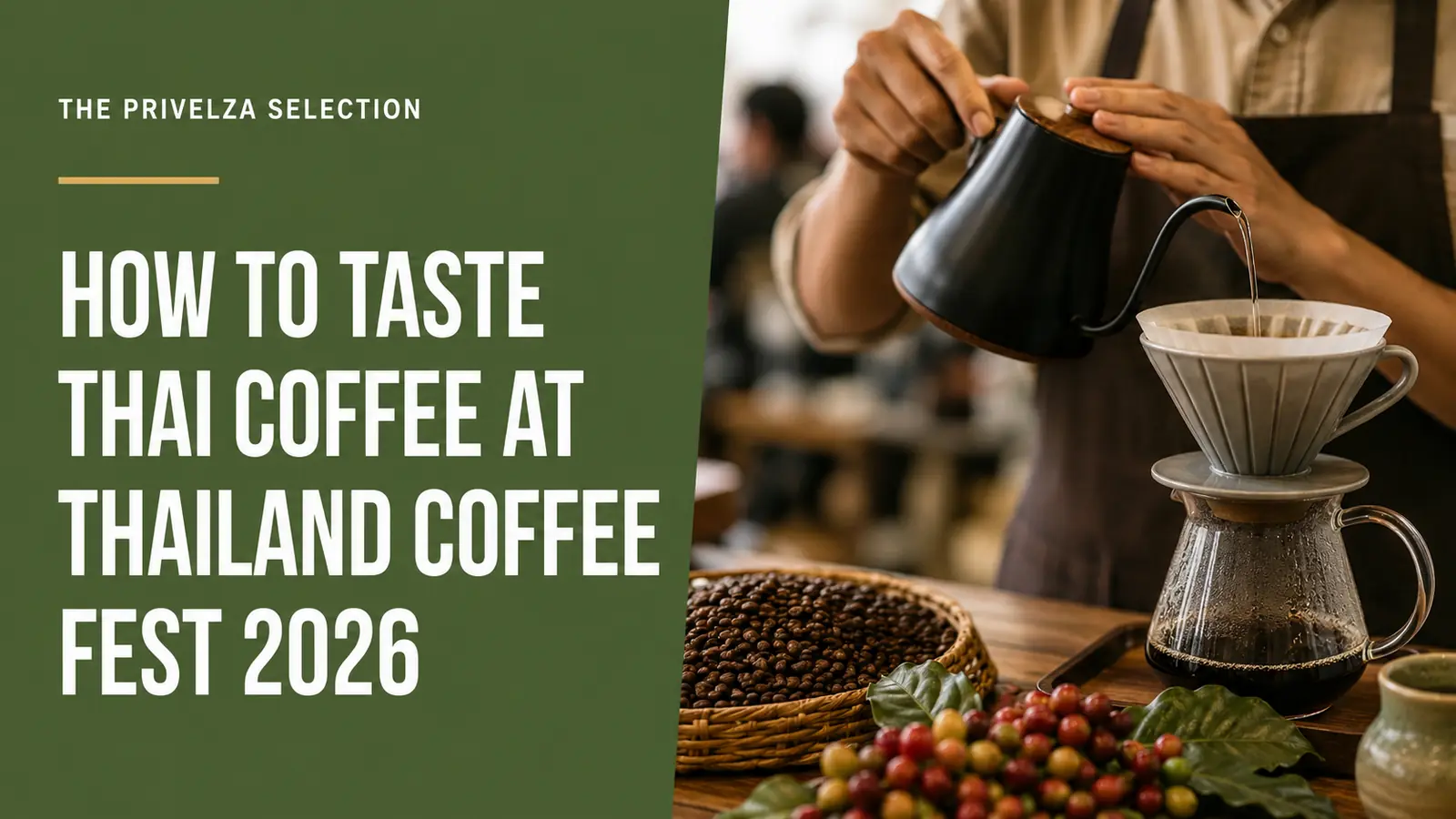
Thailand Coffee Fest can feel like a city of coffee in one building. This practical guide shows you how to compare Thai Arabica and Robusta, understand process labels, ask useful questions and build a tasting route that suits your palate.
Begin with a question, not a mission to taste everything
Thailand Coffee Fest 2026 runs from 10 to 13 September at IMPACT Exhibition Center in Muang Thong Thani. The official event programme spans Thai producers, roasters, baristas, competitions, talks, workshops and coffee from overseas. That breadth is the attraction, but it is also why a first visit can become a blur of tiny cups and half-remembered names.
The simplest way to make the day useful is to arrive with one question. You might want to understand the difference between Thai Arabica and Robusta, compare washed and natural coffees, find beans for an espresso machine, or learn why two coffees from the same province taste different. One clear question gives you a route; everything else can remain a discovery.
This is not a hunt for the objectively best cup. Coffee evaluation contains both description and preference. A coffee can be carefully produced and clearly presented without being the style you most enjoy. Your aim is to notice what changes, identify what you like and understand enough to find it again.
Know what you are comparing
A useful coffee comparison has five layers. They are often printed together on a bag or sign, but they describe different things.
- Origin: the province, district, community, farm or producer behind the coffee.
- Species and variety: commonly Arabica or Robusta, with a named cultivated variety where that information is available.
- Post-harvest process: what happened after the coffee cherries were picked, such as washed, natural or honey processing.
- Roast: how the roaster developed the green coffee for a particular style of brewing.
- Preparation: the recipe and equipment used for the cup in front of you.
Change one layer at a time when possible. Two origins brewed with the same method make origin easier to explore. One coffee prepared as a filter and an espresso shows what brewing and concentration can change. If every variable changes at once, enjoy the cup, but be cautious about drawing a firm conclusion.
Arabica and Robusta are starting points, not rankings
Arabica is Coffea arabica. Robusta is the widely used name for Coffea canephora. They are different coffee species, each containing varieties and a wide range of growing, processing and cup outcomes. The species name alone does not tell you whether a particular coffee was well grown, carefully processed, skilfully roasted or prepared to your taste.
Thailand gives you a valuable chance to compare both. An official Thai government overview associates Arabica with northern highland origins and highlights southern Robusta identities including Ranong, Khao Thalu and Tham Sing. Use those regional cues as invitations to ask about place, not as shortcuts to flavour.
At the festival, look for one clearly identified Thai Arabica and one clearly identified Thai Robusta, preferably served in comparable formats. Ask the presenter what they want you to notice. A direct comparison is more revealing than relying on the old assumption that Arabica is always refined and Robusta is always harsh.
Treat the process label as a clue
Post-harvest processing removes the outer layers of the coffee cherry and prepares the seed for storage and roasting. In a washed process, the fruit is removed and the remaining mucilage is fermented or mechanically removed before the coffee is washed and dried. In a natural or dry process, the seed dries inside the fruit layers. Honey or pulped-natural methods sit between those broad approaches, with some mucilage remaining during drying.
These methods alter the conditions around the seed and can influence the final cup, but the label is not a flavour guarantee. Variety, ripeness, fermentation control, drying, storage, roasting and brewing all matter. If a stand uses terms such as anaerobic, controlled fermentation or experimental process, ask what was actually done rather than assuming the name predicts the result.
A useful three-cup comparison is one washed, one natural and one honey or experimental coffee from Thailand. Keep the brew style similar if you can. Write down what you perceive before reading the tasting notes; then compare your impression with the producer’s description.
Separate what you notice from whether you like it
The Specialty Coffee Association’s current Coffee Value Assessment separates descriptive information from a taster’s affective response, or personal impression of quality and preference. That distinction is liberating for a visitor: you can describe a cup accurately without having to like it, and you can enjoy a cup without producing an expert vocabulary.
Use a small set of headings in your notes:
- Aroma: what you notice before and immediately after sipping.
- Sweetness: whether the cup suggests sugar, ripe fruit, caramel or another sweet association.
- Acidity: the brightness or structure you perceive, rather than automatically treating it as a fault.
- Bitterness: its intensity and whether it feels balanced with the rest of the cup.
- Body: whether the texture feels light, round, creamy, syrupy or drying.
- Aftertaste: what remains, how long it lasts and whether it is pleasant to you.
The SCA flavour wheel recommends starting with a broad impression and moving towards a more specific descriptor only when it feels clear. “Fruity” is useful. If you genuinely recognise citrus, berry or dried fruit, become more precise. There is no prize for forcing a tasting note you cannot perceive.
Understand cupping and finished drinks
Cupping is a structured way to evaluate coffee with a controlled preparation and a shared vocabulary. It helps reduce some brewing variables so coffees can be compared. A finished café drink answers a different question: how the roaster and barista turn a coffee into something you would choose to drink.
If you attend a tasting or workshop, use it to examine the coffee itself. Later, try a filter, espresso or milk drink to see how roast and preparation change the experience. Do not assume that a high competition score automatically identifies your favourite daily drink; the score and your preference are related but not identical decisions.
Ask questions that open the story
You do not need technical fluency to have a good conversation with a farmer, roaster or barista. Six direct questions are enough:
- Where in Thailand was this coffee grown, and who produced it?
- Is it Arabica, Robusta or a blend? Is the variety known?
- How was it processed after harvest?
- How was it roasted and brewed for this cup?
- What would you suggest a first-time taster notices?
- If I buy these beans, what recipe and storage advice would you give me?
Listen for specific, understandable answers. Traceability can be expressed at different levels, and not every producer will have every detail at hand. The aim is not to interrogate a stand; it is to connect the cup with the decisions behind it.
Build a three-part route through the festival
The official festival site identifies areas devoted to Thai coffee people and the Specialty Coffee Association of Thailand, international coffee, talks and workshops, competitions and products beyond the cup. Use them as anchors rather than moving randomly from stand to stand.
Part one: establish a Thai baseline. Begin with a plainly presented Thai Arabica or Robusta and record origin, process and brew method. If Thai Specialty Coffee Awards coffees are available as advertised by the venue, they can provide another reference point, but treat an award as context rather than a command to prefer the cup.
Part two: make one focused comparison. Compare two Thai origins, Arabica and Robusta, or two processes. Avoid changing every variable at once. One deliberate comparison will teach you more than ten unrelated samples.
Part three: follow curiosity. Visit an international stand, watch part of a competition, book a workshop or choose a finished drink. This is where the festival becomes pleasure again rather than a study exercise.
Check the live programme before you travel and again on arrival. Talks, workshops, competitions and registration arrangements can change, and some sessions may have separate capacity or booking rules.
Pace your palate
Small samples accumulate quickly. Begin with subtler black coffees before heavily fermented, very dark, sweetened or milk-based drinks when practical. Sip water between comparisons, pause regularly and do not feel obliged to finish every sample. If flavours start to merge, stop taking notes for a while.
Food, temperature, fragrance and fatigue can all affect what you notice. Your notes are a record of that particular tasting, not a permanent verdict on the coffee or the producer.
Buy beans you can use at home
A compelling festival cup does not automatically become the same drink in your kitchen. Before buying, check the roast date, bag size, whole-bean or ground format, recommended brew method and a starting recipe. Tell the seller what equipment you use. A smaller bag that suits your routine is often a better purchase than a rare coffee you are not equipped to brew.
Photograph or retain the label, especially the origin, process and roaster. When you brew the coffee at home, start with the recommended recipe and change one variable at a time. That turns a festival discovery into something you can learn from rather than a souvenir on a shelf.
Plan the practical details
Thailand Coffee Fest 2026 is scheduled for 10–13 September 2026, from 10:00 to 20:00, in Halls 5–8 at IMPACT Exhibition Center, Muang Thong Thani. The official venue listing states that admission is free, and attendee pre-registration is available through the festival. Confirm all details before travel.
- Check the newest programme on the Thailand Coffee Fest website.
- Use IMPACT’s official transport and parking page to plan your route.
- Wear comfortable shoes and carry water and a small note-taking method.
- Leave room in your bag if you intend to buy beans, but decide what suits your brewing setup before purchasing.
Official transport information
Leave with a map of your own taste
A successful visit does not require dozens of cups or a specialist vocabulary. If you leave knowing one Thai origin you want to revisit, one process you understand better and one question you will ask in your next café, the festival has done something valuable.
Taste slowly. Keep description separate from preference. Let producers and baristas explain the decisions behind the cup. Thai coffee becomes far more interesting when it is not reduced to a ranking, but understood as a chain of places, people and choices.
PRIVELZA CIRCLE
Join the Privelza Circle
A calmer way to discover Thailand. One thoughtful email each week, bringing together The Thailand Brief, The Privelza Selection and practical ideas for living well, travelling thoughtfully and making better-informed choices in Thailand.
Source note and disclosure
Event details were checked against the official Thailand Coffee Fest and IMPACT pages on 28 August 2026. Programmes, capacity, access and transport arrangements can change; readers should confirm the latest official information before travelling. This is independent editorial content. No commercial relationship or hosted attendance is represented.
Official Thailand Coffee Fest 2026 page
Official IMPACT transport and parking page
Specialty Coffee Association — Coffee Value Assessment
Specialty Coffee Association — How to use the flavour wheel